Description
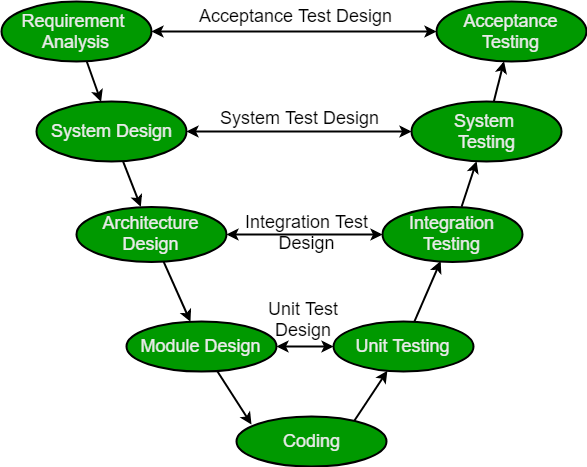
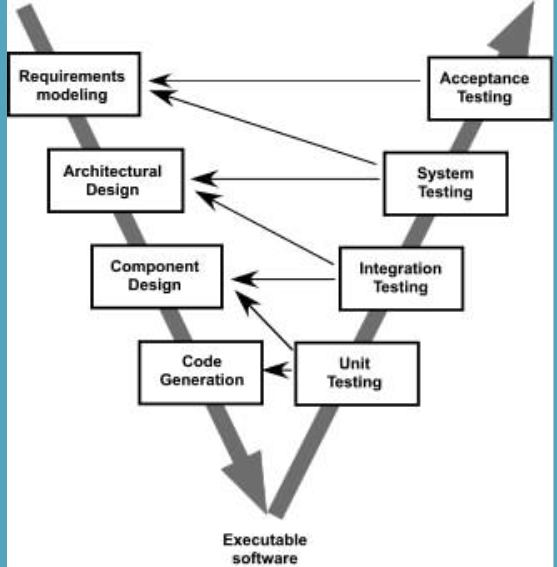
The V-Model (also known as the Verification and Validation model) is an extension of the Waterfall model, but with a focus on testing at every stage. Instead of going straight down like a waterfall, the process forms a "V" shape, the left side is development (verification), the right side is testing (validation), and they’re connected phase-by-phase.
V-Model Phases:
The V
graph LR
    R[Requirements] --> S[System design]
    S --> A[Architecture design]
    A --> M[Module design]
    M --> C[Coding]
    C --> UT[Unit testing]
    UT --> IT[Integration testing]
    IT --> ST[System testing]
    ST --> UAT[Acceptance testing]
    R -. verified by .- UAT
    S -. verified by .- ST
    A -. verified by .- IT
    M -. verified by .- UT
The dotted lines are the point of the model. Every design document on the way down has a named test level on the way up that proves it was satisfied, which is the traceable evidence regulated domains require.
Left Side: Verification (Planning & Design):
- Requirements Analysis
- System Design
- Architecture Design
- Module Design
Right Side: Validation (Testing):
Each development phase has a matching test phase:
| Development Phase | Corresponding Test Phase |
|---|---|
| Requirements Analysis | Acceptance Testing |
| System Design | System Testing |
| Architecture Design | Integration Testing |
| Module Design | Unit Testing |
Advantages:
- Early testing planning improves quality.
- Clear links between development and testing.
- Errors can be caught early.
- Better suited for high-reliability systems (like aerospace, medical software, etc.)
Disadvantages:
- Still rigid, not great for changing requirements.
- No early working prototypes.
- More complex than Waterfall.
Diagrams