Description
The Incremental Model combines elements of the Waterfall model with iterative development. Instead of delivering the whole system at once, it delivers functional components (increments) over time:
- The product is designed, implemented, and tested incrementally (a little more is added each time).
- Each increment adds new functionality.
- The first increment is usually the core product, additional features are built on top of it.
Structure:
- Initial Planning
- Design Increment 1 → Build → Test → Deliver
- Design Increment 2 → Build → Test → Deliver
- ...Repeat until complete system is delivered
Advantages:
- Useful when not all requirements are known up front.
- Delivers working software early and often.
- Easier to test and debug smaller increments.
- User feedback can be integrated between increments.
Disadvantages:
- Needs good architectural planning.
- Later increments might require rework of earlier ones.
- System design issues may arise if not all requirements are known.
Diagram
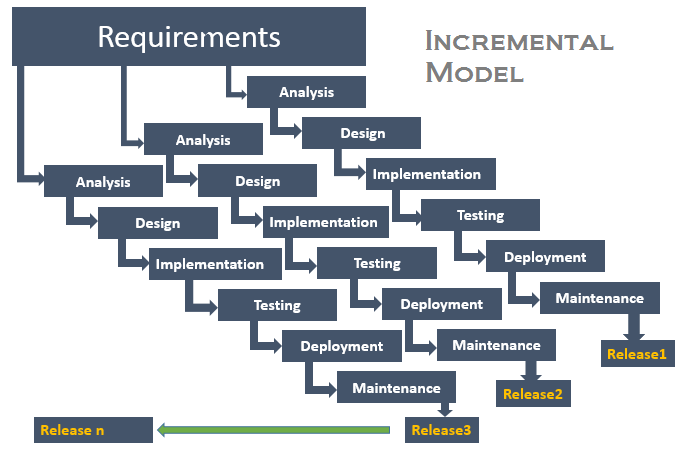
How the increments stack up
graph TD
    RQ[Full requirements known up front] --> P[Split into increments]
    P --> A["Increment 1: core, design, build, test, deliver"]
    A --> B["Increment 2: adds features, design, build, test, deliver"]
    B --> C["Increment 3: completes the scope"]
    A -. in use by customers .- U[Users]
    B -. in use by customers .- U
    C -. in use by customers .- U
Each increment is a working part of the final product, so users get value before the whole scope is finished, and feedback arrives while later increments can still change.